Starting yoga at home looks easy. You open your laptop, type “yoga for beginners”, and suddenly there are thousands of videos and you have no idea where to begin. After twenty years teaching hatha yoga and training teachers (RYT 500 with the Yoga Alliance), I can tell you the first week is what decides whether you stay with this for years or quit before the second Monday.
So here is the same plan I give my own students when they start: a 7-day guide with the bare minimum, one posture per day, and the specific mistakes worth avoiding. It is not a demanding challenge. It is the opposite: a kind, sustainable, technically sound starting point so your body and mind get familiar with the practice.
What you actually need (and what you don’t)
Essential
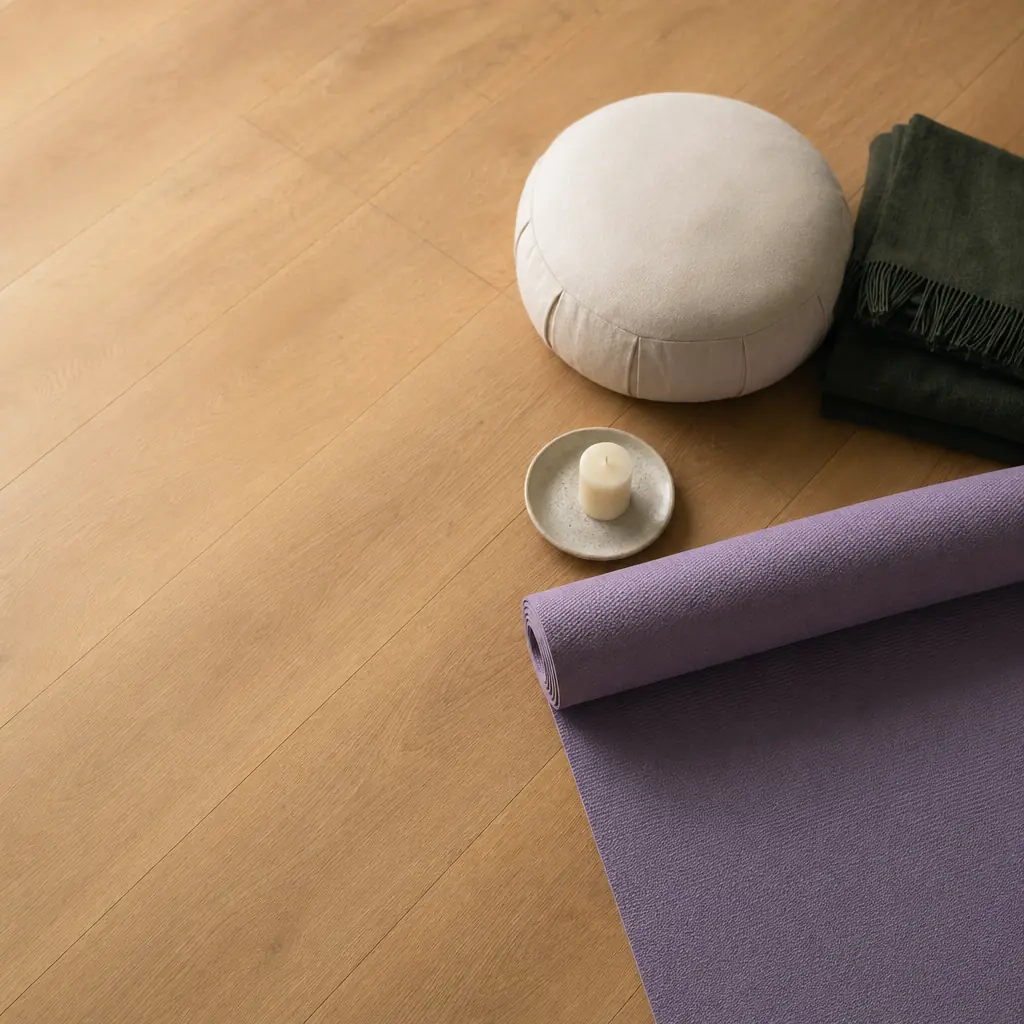
- A grippy mat. Not the prettiest one, not the most expensive one — the one that doesn’t slip when your hands sweat. 5–6 mm thick is plenty.
- Comfortable clothing that doesn’t slide down when you bend forward. Flexible trousers and a top that won’t cover your face in inversions.
- A clear space of about 2×1 metres. You don’t need a dedicated yoga room: a corner of the living room with the chair pushed aside is fine.
- 15 to 30 minutes a day. Practising 20 minutes seven days in a row is more effective than 90 minutes one Saturday and nothing the rest of the week.
Useful but optional
- Two yoga blocks (cork or foam). They bring the floor closer to your hands when your flexibility doesn’t reach yet. Two thick books do the same job for now.
- A folded blanket for cushioning the knees, sitting taller in seated postures and staying warm in final relaxation.
- A strap for binds where your hands don’t yet meet.
None of this is needed in week one
Paid apps, singing bowls, technical clothing, fancy crystal-decorated studios, a premium cork mat or a hundred-euro monthly membership. All of that can come later if you want it. The first week, the only thing you need is to show up every day.
Your day-by-day plan (week 1)
The logic of this plan is to introduce slowly the main pillars of yoga: alignment, breath, gentle strength, flexibility and rest. Each day adds one new posture on top of the previous day. Always warm up for 2–3 minutes with conscious breathing first.
Day 1 · Tadasana, mountain pose
Yes, standing is yoga too. Tadasana is the root posture of hatha yoga: it teaches you to hold your own weight on a clear axis, to drop the shoulders away from the ears, and to breathe with a free diaphragm. Practise 3 minutes barefoot, feeling the weight distribute across the four corners of each foot. It is the base on which every other standing posture is built.
Day 2 · Urdhva hastasana, raised arms
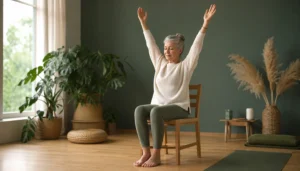
From tadasana, lift the arms above the head with palms together or parallel. Urdhva hastasana opens space for the diaphragm, lengthens the spine and starts mobilising the shoulders. 5 long breaths. Today: 3 min of tadasana + 2 min of urdhva hastasana.
Day 3 · Uttanasana, standing forward fold
With knees softly bent, fold the torso towards the thighs. Whether your hands reach the floor or not is irrelevant: the goal is to lengthen the spine and release the lower back and hamstrings. If the hands don’t reach, rest the forearms on two blocks or two thick books. 5–8 breaths.
Day 4 · Adho mukha svanasana, downward facing dog
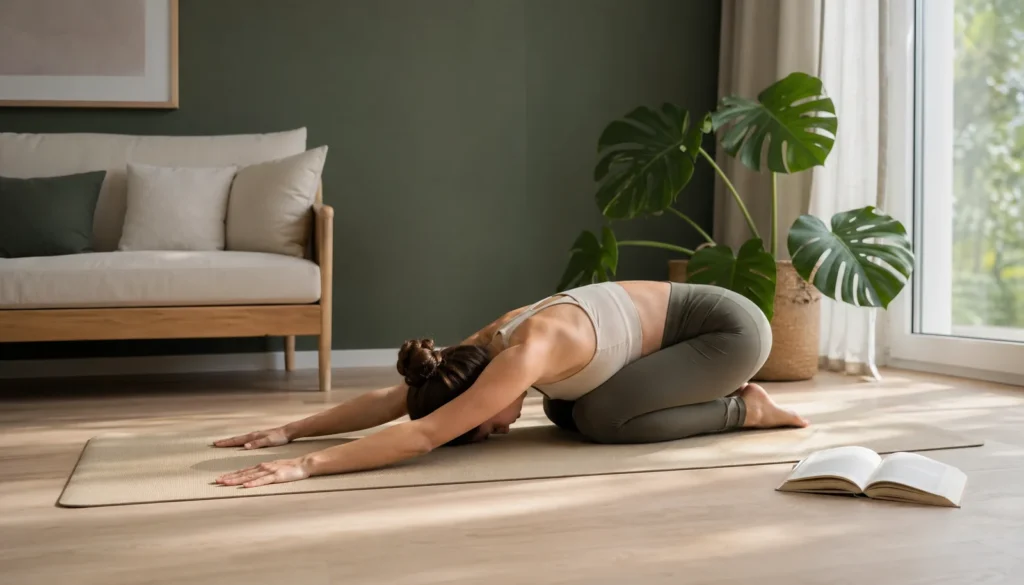
The most recognisable posture in modern yoga and also the one most often misperformed when learnt alone. The key: knees bent, sit-bones pointing to the ceiling, spine long and diagonal. If the back rounds, bend the knees more. 5 breaths, rest in child’s pose, repeat. You’ll learn this posture in its natural context inside the complete 12-posture sun salutation.
Day 5 · Sukhasana with 4-4 breath
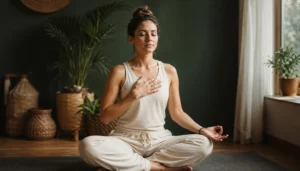
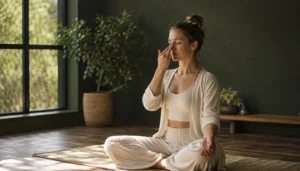
Today you sit. Sukhasana, the easy cross-legged seat, on a cushion or a folded blanket so your hips sit higher than your knees. This is your first taste of pranayama: inhale 4 seconds, exhale 4 seconds. 5 minutes. You will notice your head settle.
Day 6 · Simplified sun salutation
Today you link. Tadasana → Urdhva hastasana → Uttanasana → half-lift gaze → Uttanasana → Tadasana. Three calm rounds. It is not the classical sun salutation (that has 12 postures and you’ll meet it later), but it weaves together everything from the previous days into one breath-led sequence.
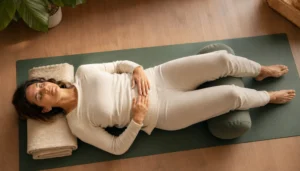
Day 7 · A 10-minute savasana
The pivotal day of the week, even though it looks the easiest. Lie on your back, legs apart, arms a little away from the torso with palms up. Ten minutes without moving. If you have never rested consciously, those ten minutes can feel endless. That is exactly what your nervous system needs to integrate the week.
“Yoga is not about touching your toes; it is what you learn on the way down.”
Donna Farhi, Bringing Yoga to Life (2003)
Five mistakes I see every year in new students
- Chasing the “perfect” posture before chasing the breath. A misaligned posture with smooth breath is worth more than a flawless posture with held breath.
- Skipping the warm-up. Two minutes of breath and joint mobility dramatically lower the risk of lower-back discomfort.
- Forcing flexibility. Yoga is not won through force. Sharp pain means come out. Mild discomfort means stay and breathe.
- Skipping the final rest. Skipping savasana is skipping the integration. If your session is 20 minutes long, the last 5 are for lying down.
- Comparing your day 5 to a 10-year practitioner’s Instagram reel. Their body and history are not yours. Practise from where you are today.
Home practice or studio? The honest answer
Starting at home is ideal for week one because it removes the “I don’t feel like going out today” barrier. But once the habit is in place, I recommend adding at least one in-person guided class every two weeks. A good teacher’s corrections on your own alignment are irreplaceable, especially in load-bearing postures (downward dog, standing sequences). At my studio in Barcelona Horta I keep classes small precisely so that individual attention is possible.
And from week two onwards?
Once you complete the 7 days, you have three possible directions. If your body wants more flow, move on to the full sun salutation. If you want to understand what lies beneath the postures, start reading about the yamas and niyamas, the ethical foundations of yoga. If you discover that what you really seek is emotional regulation, explore therapeutic yoga. All three roads share the same base: a well-built first week.
Frequently asked questions
How long until yoga starts to show results?
The nervous system responds on day one (you’ll notice the calm afterwards). The body, in mobility and posture terms, around 3–4 weeks with near-daily practice. Steady strength and real flexibility take months, but you’ll already sleep better after the first month.
I’m over 50 — is it too late to start?
Quite the opposite. The age range where yoga makes the biggest visible difference in quality of life is between 50 and 75. The approach simply changes: more block- and chair-assisted postures, less strength demand. Any well-adapted hatha yoga works.
Do I need to be flexible to start?
No. Flexibility is the result of yoga, not a prerequisite. If touching your toes feels impossible today, perfect: that is exactly your useful starting point.
What if something hurts during practice?
Distinguish discomfort (a sustained stretch — exit after 30 seconds if you need) from sharp or stabbing pain (exit immediately and review the alignment). If it happens again, find an in-person class where someone can correct you live.
If after this first week you want real guidance, at my yoga studio in Barcelona we work with classical hatha yoga, therapeutic yoga and yoga for grief in small groups. First trial class is free.