
Yoga during pregnancy is not regular yoga, just gentler. It is an accompaniment that changes with the body and adapts differently in each trimester. What is perfectly safe in week 12 may be unsuitable in week 30, and vice versa.
In this guide I’ll detail what to practise and what to avoid trimester by trimester, with the logic behind each adaptation. The information is based on my specific prenatal yoga training and on guidelines from the American College of Obstetricians and Gynecologists (ACOG) and the International Association of Yoga Therapists. Important: this is general information. Every pregnancy is different and the final word is always your obstetrician’s or midwife’s.
Before you start: when yes and when no
Prenatal yoga is suitable for most uncomplicated pregnancies. ACOG recommends 150 weekly minutes of moderate physical activity in low-risk pregnancy, and adapted yoga fits perfectly within that recommendation.
Consult your medical professional before starting if you have:
- High-risk or twin pregnancy.
- Vaginal bleeding at any time during pregnancy.
- Diagnosed placenta previa.
- Preeclampsia or pregnancy-induced hypertension.
- Short cervix or risk of preterm labour.
- Any pre-existing medical condition flagged as caution by your obstetrician.
First trimester (weeks 1-13)
The first trimester is the most delicate for two reasons: miscarriage risk is higher (especially in the first 12 weeks) and many women don’t yet feel well (nausea, extreme fatigue). The general recommendation is to moderate practice more than at any other time.
What to practise
- Soft standing postures: tadasana, urdhva hastasana, vrksasana (tree) if you feel stable.
- Seated: sukhasana, baddha konasana (butterfly), upavistha konasana (gentle wide-legged opening).
- Breath: conscious diaphragmatic breathing, gentle ujjayi (no retentions).
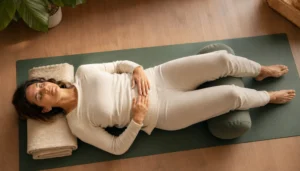
- Relaxation: left-side savasana from late first trimester onward.
What to avoid
- Hot yoga, bikram, aerial yoga.
- Pranayama with long retentions or forceful breathing (kapalabhati, bhastrika).
- Deep inversions if you haven’t practised them before: sirsasana, sarvangasana.
- Jumps in sun salutation ashtanga style.
- Prone postures compressing the abdomen (from week 8, even if the body doesn’t yet protest).
- Closed twists towards the abdomen.
Second trimester (weeks 14-27)
The most comfortable trimester. Nausea usually subsides, energy returns and the body still allows a wide range of movement. The ideal time for a regular, well-structured practice. But the baby’s space already needs respecting.
What to practise
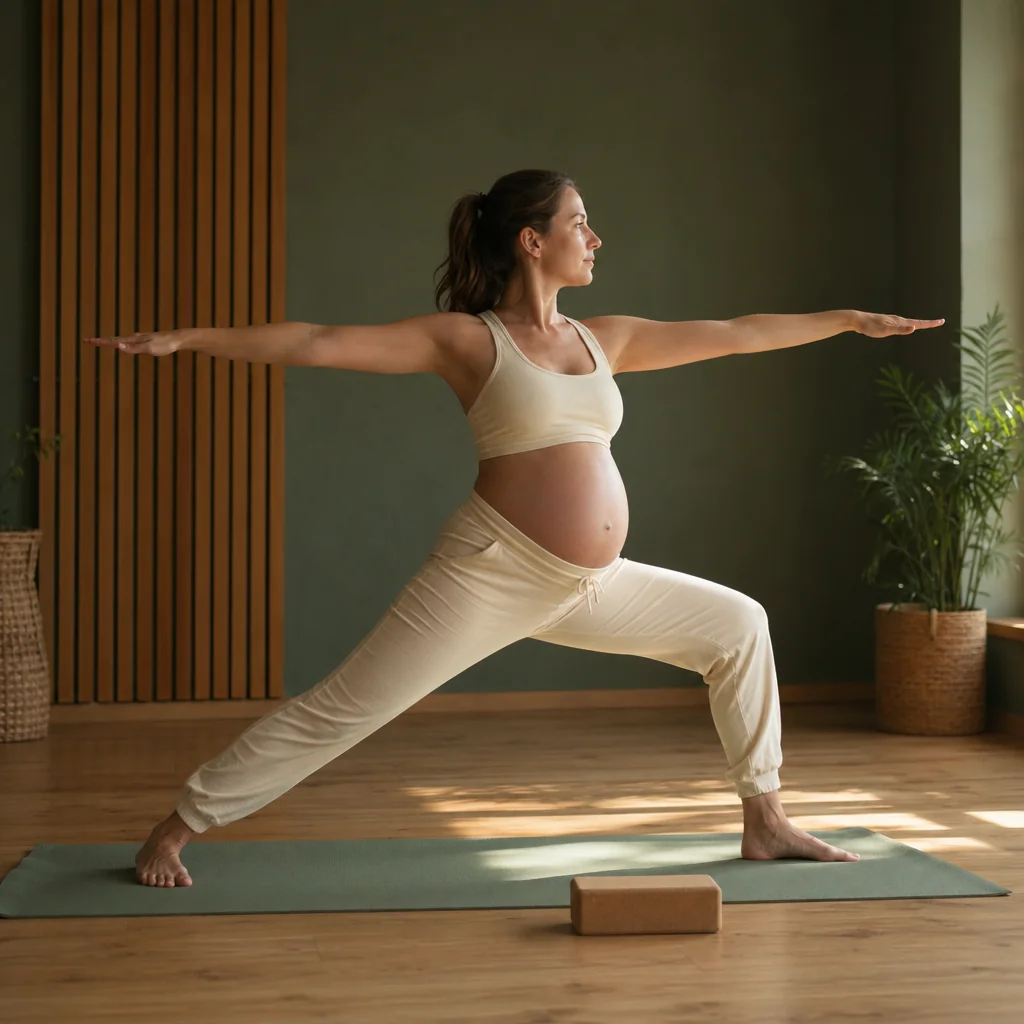
- Standing postures with opening: virabhadrasana II (warrior II) with a wide base, utthita parsvakonasana (side angle), gentle trikonasana with a block.
- Hip-opening postures: baddha konasana, malasana (squat) with support, upavistha konasana.
- Soft thoracic extensions: gentle bhujangasana (no abdominal pressure), elevated cobra variations.
- Pranayama: diaphragmatic breath, nadi shodhana (alternate-nostril, no retentions).
- Relaxation: left-side savasana with pillows.
What to avoid
- Prone postures.
- Prolonged supine savasana from week 20: the weight of the uterus compresses the vena cava and reduces venous return. Always left-side.
- Closed twists towards the abdomen. Open twists (away from the abdomen) are safe.
- Extreme stretches: relaxin loosens the ligaments and increases overstretch risk. Practical rule: aim for 80% of your usual range, not 100%.
- Balance postures without a wall or chair nearby: the centre of gravity has shifted and falls are more likely.
Third trimester (weeks 28-40)
The body no longer allows the same practice. Focus shifts to birth preparation, comfort and breathing. Static postures take centre stage; dynamic flows step back.
What to practise
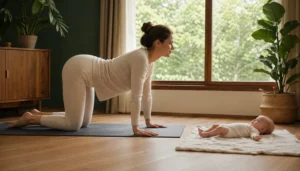
- Hip-opening postures: wall- or block-supported malasana (excellent birth preparation), sustained baddha konasana, cat-cow on all fours.
- Wide-base all-fours posture: relieves lumbar pressure and improves foetal position in the last weeks.
- Birth-oriented breathing: long audible exhale, OM sound or soft vibratory sound.
- Visualisation and meditation.
- Left-side relaxation with plenty of pillows: under the head, between the legs, hugged in front.
What to avoid
- Everything from the second trimester + prolonged floor postures that are hard to leave.
- Standing-on-one-foot postures (much higher fall risk).
- Any posture that compresses the lower abdomen.
“Prenatal yoga does not seek to change the pregnancy, but to accompany the woman on her journey with body, breath and attention.”
Janice Clarfield, Yoga for Pregnancy (1997)
Is it safe to start yoga in pregnancy if I never practised before?
Yes, with three conditions. First: wait until the second trimester if you’ve never done yoga, not because it’s dangerous before, but because your body is already adapting to many changes — adding a new technique in the middle of first-trimester hormonal readjustment can become overstimulation. Second: look for specific prenatal yoga classes, not “I’ll join a regular class and modify”. Third: a teacher with specific prenatal yoga training and documented experience supporting pregnant practitioners.
Postpartum: when and how to return
The first month postpartum is for resting, not for returning to the mat. General recommendation: wait for the postpartum check-up at 6 weeks (or 8-10 if it was a C-section) before resuming. The return starts with adapted postpartum yoga focused on pelvic floor, diastasis recti and abdominal-wall reorganisation. Returning to a regular practice can take 3-6 months when integration is done well.
How we work at Yoga Clio
At my Barcelona studio I offer prenatal yoga in individual and small bilingual group formats (ES/EN), with trimester-specific adaptations. If you join from the first trimester, we begin with an interview to review your history and adjust the practice. If you arrive in the second or third trimester, we start from where you are. Online individual sessions are available for when getting to the studio is complicated.
If interested, the first step is to schedule an initial conversation. I’ll explain how I work and how it fits your current trimester.