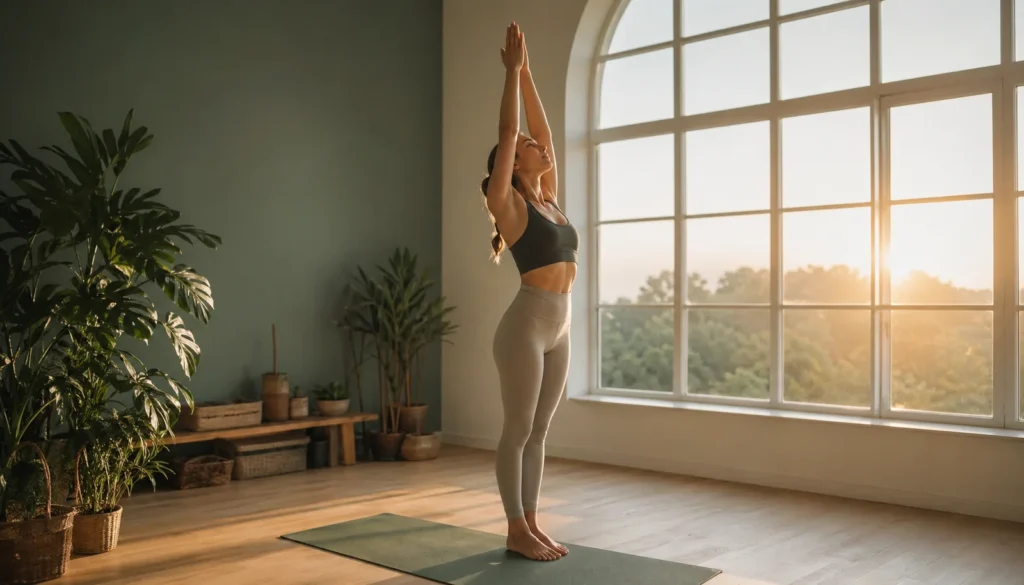
The sun salutation —Surya Namaskar in Sanskrit— is not just a pretty warm-up sequence. It is the spine of modern hatha yoga: twelve postures linked by the breath which, performed with attention, give you in ten minutes what many fitness routines try to deliver in an hour — mobility, functional strength, cardiovascular regulation and a settled nervous system.
After twenty years practising and teaching this sequence (trained at Sivananda Ashram, India, and RYT 500 with the Yoga Alliance), I can tell you almost no self-taught practitioner gets the full sun salutation right the first time. And that is normal: it has layers. In this guide I walk you through the classical 12-posture version in detail — proper alignment, the breath that goes with each movement, and the most common mistakes — so you can integrate it well into your home practice.
What it is and where it comes from
The Surya Namaskar as practised today —twelve postures in a closed cycle— became popular in early-20th-century India, linked to the Raja of Aundh and to Krishnamacharya, the father of modern hatha yoga. Earlier devotional sun rituals existed, but the body-and-mind exercise as we know it is relatively recent.
Its logic is simple and brilliant: extensions alternate with flexions of the spine, vertical with horizontal plane, concentric strength with elongation, all linked by the breath. That is why it works as warm-up, as a complete short practice, and as moving meditation.
The 12 postures, one by one
I’ll describe the classical version (Sivananda / Krishnamacharya style). Ashtanga (salutation A and B) and vinyasa variants exist with differences: learn this one first and you’ll understand all the others.
1. Pranamasana — salutation pose
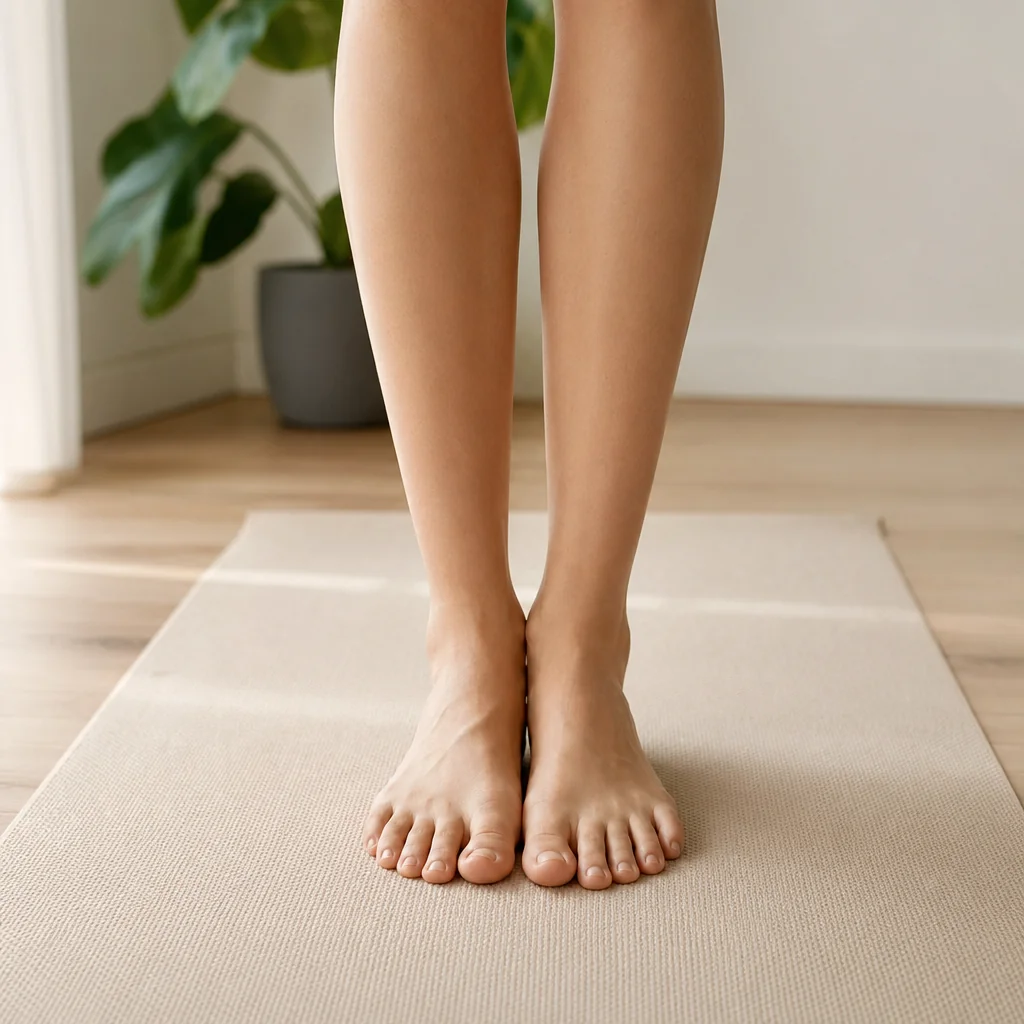
Standing in tadasana, palms together at heart level. Feet together and parallel, weight evenly through the four corners of each foot, spine long, shoulders away from the ears. No specific breath is started yet: you are setting the axis. 2 centring breaths.
2. Hasta uttanasana — raised arms with backbend
Inhale while lifting the arms overhead and slightly extending the spine backwards. The extension comes from the chest and mid-back, not from the lower back. Gaze towards the thumbs.
3. Padahastasana — standing forward fold
Exhale and fold the torso towards the thighs, with knees softly bent if your flexibility doesn’t yet allow them straight. Hands to the floor beside the feet, or onto two blocks. Neck released, crown towards the floor.
4. Ashwa sanchalanasana — low lunge
Inhale and step the right leg back. Right knee to the floor, left knee aligned over the ankle (no further). Open chest, gaze forward, fingertips on the floor beside the front foot or on blocks.
5. Phalakasana — high plank
Hold and step the left leg back to meet the right in high plank: body in a straight line from crown to heels, hands under shoulders, glutes engaged, core supported. Hips neither sagging nor rising.
6. Ashtanga namaskara — eight-point salute
Exhale and lower like a controlled folding ladder, touching knees → chest → chin to the floor while the hips stay lifted and elbows hug close to the body. The only posture in the salutation grounded at eight points: two feet, two knees, two hands, chest, chin.
7. Bhujangasana — cobra
Inhale and slide forward: legs extended with insteps on the floor, hands under shoulders, elbows close to the torso, chest lifted. The extension comes from the mid-back, not the lower back. Elbows do not need to be fully straight: the height is set by your thoracic mobility, not your arm strength.
8. Adho mukha svanasana — downward facing dog
Exhale lifting the hips up into the inverted V. If the back rounds or heels lift much, bend the knees. The priority is a long spine, not heels on the floor. Take five breaths here if you want to extend the sequence.
9. Ashwa sanchalanasana — low lunge (other side)
Inhale stepping the right foot forward between the hands. Same alignment as posture 4, this time with the opposite leg forward. Back knee on the floor or floating, depending on your strength.
10. Padahastasana — standing forward fold
Exhale bringing the feet together and folding the torso towards the thighs. Same alignment as posture 3.
11. Hasta uttanasana — raised arms
Inhale rising up with arms extended through the sides to overhead, opening the chest.
12. Pranamasana — final salute
Exhale bringing the palms to the chest. You have completed half a cycle. The next round starts with the left leg in posture 4 (lunge). That completes a full sun salutation.
“In the sun salutation all qualities of the body converge: strength, flexibility, balance and breath. It is a practice that in itself contains yoga.”
B.K.S. Iyengar, Light on Yoga (1966)
How to build your sun salutation practice
- Beginner (weeks 1-3): 3 gentle rounds, clear pauses at each posture to check alignment. 8-12 minutes.
- Intermediate (months 2-3): 6 rounds with smooth breath, holding downward dog 5 breaths each round. 15 minutes.
- Advanced: 12 rounds (6 per side) at continuous tempo, integrating bandhas and drishti. 20-25 minutes.
As a warm-up for a longer practice, 3-5 calm rounds are enough. As your full practice on a short day, take it up to 6-12 rounds with a 5-minute savasana at the end.
Common mistakes (and how to fix them)
- Hyperextending the lower back in cobra. The arch comes from the mid-back, not the lower back. If you feel pinching, lower the chest.
- Sagging hips in plank. Engage glutes and core. If you can’t hold, drop to the knees.
- Forcing heels to the floor in down dog. Not required. Prioritise spinal length. Heels descend on their own with time.
- Tense neck in cobra. Shoulders away from ears, cervical spine in line with thoracic.
- Holding the breath. If you run out of air, slow down. Breath leads; body follows.
Real benefits (what is actually documented)
Regular sun salutation practice shows measurable improvements in flexibility, muscular strength and cardiovascular endurance in controlled studies. Exercise physiology research places its metabolic cost roughly equivalent to brisk walking, with the added benefit of joint mobility and breathing work that walking alone doesn’t deliver. It is not a substitute for high-intensity strength or cardio when chasing specific athletic goals, but it is a thoroughly sufficient and well-rounded practice for general health.
When not to practise it (or to adapt it)
- From the second trimester of pregnancy: avoid deep forward folds and ashtanga namaskara. Replace with adapted prenatal yoga.
- Uncontrolled hypertension or vertigo: avoid deep forward folds with the head below the heart.
- Active lower-back injury: work first with a teacher in person; substitute with a block-supported modified version.
- Disc herniation: avoid deep folds; assess case by case with your physiotherapist and a therapeutic yoga teacher.
Going deeper
If you’d like to go further into the anatomy of each posture, see the guide on the anatomy of the sun salutation. And if you’re in Barcelona and prefer learning it in person, at my Horta studio we work with the sun salutation through individual corrections in small classes. First class is a free trial.