
There is a moment in grief when you discover that words do not reach. Not because there is nothing to say. It is because the pain is not where words can touch it. It is somewhere else: in the chest, in the throat that will not open, in the legs that feel heavy, in the sleep that does not come.
Grief is not processed only by thinking. The body is where loss truly lives, and where, slowly, room is made to hold it.
I am Clio Byrne, hatha yoga teacher (RYT 500 by Yoga Alliance) with over a hundred hours of specific training in Grief Yoga, an internationally recognised certification for accompanying loss processes from the body. I have been working for years with people in grief in my classes and individual sessions. What follows is what I have learned and what physiology confirms: yoga can hold grief in a way the mind alone cannot.
Grief is not linear: beyond the «stages»
You have probably heard of Elisabeth Kübler-Ross’s five stages of grief: denial, anger, bargaining, depression, acceptance. It is one of the best-known models. Also one of the most misunderstood.
Kübler-Ross herself did not describe these stages as a linear or obligatory path. She observed them in terminal patients accepting their own death. Pop culture later turned them into a roadmap: «I am on stage 3, time to be angry and then start accepting».
The reality of grief is different. It is circular, repetitive, contradictory. You can pass through acceptance one morning and through anger that same afternoon. You can feel functional for weeks and then break one evening because of a song. You can not cry at all for six months and, in the seventh, not stop.
This is not «doing it wrong». It is the natural way the body processes loss.
Why the body holds what the mind cannot face
Modern psychiatry —especially since the work of Bessel van der Kolk— has confirmed what contemplative traditions always knew: the body holds what the mind cannot bear.
When a great loss happens, the emotional brain (limbic system) records everything: the exact moment, the sensations, the smells, the words. The rational brain tries to process. But there is a part of the impact the mind cannot cover, and it stays lodged in the body: tense shoulders, clenched jaw, shallow breath, recurring headache, a heaviness with no name.
If that bodily record is not worked, it can stay for years. There are people in «unresolved» grief ten years after the loss who arrive in consultation with physical symptoms with no medical explanation. The body is waiting to be heard.
Nervous system, polyvagal theory and the trauma of grief
Stephen Porges’s polyvagal theory describes how the autonomic nervous system responds to danger. In acute grief —especially after sudden loss— the same circuits as in trauma are activated:
- Hyperactivation: anxiety, insomnia, hypervigilance, racing heart. The body cannot come down from high gear.
- Hypoactivation: apathy, a feeling of «being far away», disconnection, deep exhaustion. The body «shuts down» to protect itself.
- Oscillation between the two: most common. Days of hyperactivation followed by days of collapse.
Coming out of these states is not done with reasoning. It is done by regulating the nervous system from the body. And that is where yoga offers something concrete.
«Grief turns out to be a place none of us know until we reach it.»
— Joan Didion, The Year of Magical Thinking (2005)

How yoga steps in: breath + movement + holding
Yoga for grief is not «softer» yoga. It is a specific approach that combines three elements:
Conscious breathing. Pranayama techniques —especially the full yogic breath and nadi shodhana (alternate nostril breathing)— activate the vagus nerve and return the body to a parasympathetic state. This lowers cortisol and allows the nervous system to feel safe again. More on this in my article on pranayama.
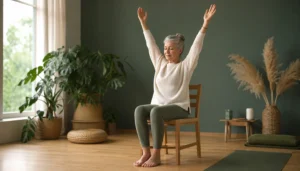
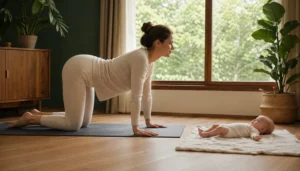
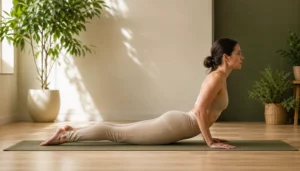
Sustained movement. Not intense movement. Asanas that gently open the chest, restorative postures that hold us, slow sequences that bring back the sense of inhabiting the body. When grief contracts us, contained movement gives us space again.
Emotional holding. The difference from a «regular» yoga class is that in yoga for grief we know intense emotions can arise. The practice is designed to hold what emerges, not to force calm. Sometimes there are tears in savasana. Sometimes laughter. Both are welcome.
A gentle practice for difficult days (3 restorative asanas)
If you are having a very hard day and need something concrete, this 15-minute sequence can help. You will need: a blanket and two pillows or bolsters.
1. Supported child’s pose (balasana)
Kneel on the mat. Take the knees apart and bring the big toes together. Place a bolster between the legs, then fold forward resting your whole torso on the bolster. Turn the head to one side. Arms relaxed.
Stay 5 minutes, breathing slowly. This pose closes the body in on itself and provides the sense of shelter that grief sometimes needs.
2. Supported chest opener
Lie on your back with a bolster or pillow under your shoulder blades (not under the head), so the chest opens gently. Arms wide, palms up.
Stay 5 minutes. This pose literally opens the heart space. Grief sometimes closes us there; opening little by little with support helps.
3. Savasana with a blanket
Lie fully on your back, cover yourself with a blanket up to the shoulders. Close your eyes.
Stay 5 minutes. Doing nothing. Without «trying to relax». Just letting the body be.
If tears or strong emotion arise in any of these poses, let them come. It is not a mistake. It is the practice.
How to accompany someone in grief: what to say and what to avoid
I am often asked this. Leaving it here in case it serves you or someone close:
What helps:
- «I am here.» (And then actually being.)
- «I do not know what to say, but I love you.» Honest. Enough.
- Being present without needing to «fix» anything.
- Offering concrete help: «Tomorrow I will come do the shopping» instead of «Let me know if you need anything».
- Accompanying in silence.
What to avoid:
- «It was their time / They are in a better place.» These are consolations for the speaker, not the receiver.
- «You have to be strong.» This puts pressure not to feel.
- «I know how you feel.» Even if you went through something similar, every grief is its own.
- Timetables: «It has been a year, you should be feeling better.» Grief does not follow the calendar.
How we work with grief at Yoga Clio
At the Horta studio I offer two specific formats to accompany grief:
- Yoga for grief classes: in-person and online sessions, individual and small group. A held space, pace adapted to each person.
- Online yoga course for grief: for those who prefer to work at home at their own pace. Practice guided by me, accessible whenever you have time.
If the sound dimension resonates with you, I also integrate therapeutic voice and sound therapy when it serves. There are moments when sound —singing, vibrating, making noise with the body— releases what words cannot reach.
More about my specific training in yoga for grief and my own path with loss: about me.
Frequently asked questions
When is a good time to start practising yoga during grief? There is no «right» time. Some people need to move from day one. Others need weeks or months of stillness before they can. Both are fine. When a small impulse to do something for yourself appears, that is the moment.
Do I need previous yoga experience? No. Yoga for grief classes are designed to welcome people without experience. If you have been still for a while, it is also a perfect way to gradually return to the body.
Can I combine yoga for grief with psychological therapy? It is what I recommend. Yoga works from the body; therapy from words and conscious elaboration. The two paths complement each other.
Is it for any kind of grief? Yes. Loss of a loved one, significant relationship breakup, loss of health, loss of a job or life stage. The body processes all losses with similar mechanisms.
Does it require time having passed since the loss? No. We work with recent grief and with old, unprocessed grief. Each moment of the process asks for different things.
Grief is not «overcome». It is moved through. And it is moved through better when the body is part of the path, not a silent obstacle.