If you have chronic back pain, you’ve been hearing contradictory advice for a long time. Rest. Movement. Stretching. Core strengthening. Yoga. No yoga because “it can hurt you”. The noise is huge. Here’s what the evidence says and what my clinical experience accompanying students with lower back pain confirms.
Since 2017, the American College of Physicians explicitly includes yoga among the first-line recommended treatments for chronic lower back pain, with a level of evidence comparable to cognitive-behavioural therapy and pharmacological treatment. Here is why it works, what to practise, what to avoid and how to build a safe routine.
Why yoga helps with chronic pain

Chronic pain is not only a mechanical problem of the spine. It is a system with two components:
- Tissue component: stiffness, weak deep musculature, poor load distribution.
- Nervous component: sensitised central nervous system that amplifies pain signals.
Yoga acts on both. It improves body mechanics with dosed postures and, simultaneously, reduces nervous-system sensitisation through breath, body attention and parasympathetic regulation. That is why it succeeds where interventions targeting only one component fail.
The 6 safe (and useful) postures
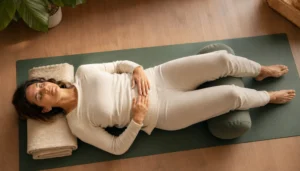
1. Apanasana — knees to chest
Supine, knees to chest, hands hugging the shins. Soft circular pelvic movements. Decompresses the lumbar zone. 1-2 minutes on waking and before bed.
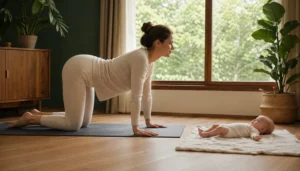
2. Marjaryasana-bitilasana — cat-cow
On all fours. Inhale arching the spine (cow), exhale rounding it (cat). 8-10 slow cycles following the breath. Improves segmental spinal mobility without axial load.
3. Setu bandhasana — bridge
Supine, feet near glutes, lift the pelvis pressing the feet into the floor. Activates glute musculature (glute hypotonia is a frequent cause of lumbar pain). 5 lift-and-lower cycles.
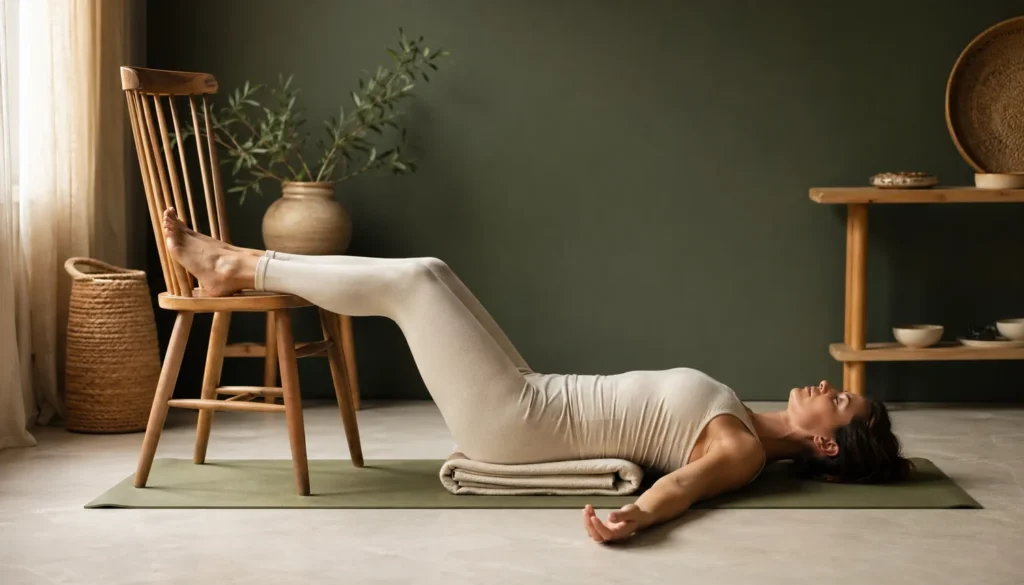
4. Legs up the wall (or chair)
Supine with legs raised on a chair or wall. Arms relaxed at the sides. 5-10 minutes. Deeply releases the lumbar region. Excellent at end of day.
5. Soft bhujangasana — low cobra
Only low cobra, not high. The arch comes from the sternum forward, not from arm push. Activates lumbar multifidi and paravertebral muscles.
6. Phalakasana — modified plank
Plank on knees and forearms. Hold 20-40 seconds. Activates the deep core, essential for lumbar stability. Start with 20 seconds × 3 sets, progress to 40 seconds.
“Movement is medicine. Sustained immobility is what chronifies pain.”
Saper et al., Annals of Internal Medicine (2017) — the study that led to the ACP recommendation
What to avoid (and why)
- Deep forward folds with straight legs. Load the discs in flexion — exactly the opposite of what you need.
- Forced deep twists. If you have herniation or protrusion, closed twists can worsen things.
- Deep full-arch backbends (urdhva dhanurasana). Too much lumbar facet load.
- Postures held without variation more than 2-3 minutes. Sustained immobility also damages.
- Yoga on a mattress or unstable surface. The body needs the floor to reorganise properly.
12-minute daily routine
To start seeing real changes in 4-6 weeks:
- Morning (5 min): apanasana 1 min · cat-cow 8 cycles · setu bandhasana 5 cycles · low cobra 3 cycles.
- Afternoon or night (7 min): phalakasana 20 sec × 3 · legs up the wall 5 min.
When to consult before practising
- If your pain started from undiagnosed recent trauma.
- If there’s pain radiating into the leg with tingling or strength loss (may be sciatica, requires diagnosis).
- If you’ve had spinal surgery in the last 6 months.
- If pain worsens at night in bed (may have non-mechanical cause).
- If there’s associated loss of sphincter control (medical urgency).
If your back pain is chronic, an individual therapeutic yoga session with a personalised protocol gives better results than a group class.