If you could only take one breathing technique to manage anxiety, the 4-8 breath would be it. The simplest, the safest, the fastest to produce measurable effect, and the one with the fewest prerequisites. You don’t need prior yoga, no special mudras, no significant contraindications. And in five minutes, it can bring down an acute crisis.
Here is exactly what it is, why it works, how to practise it well and when it is most useful. Also when it isn’t the right tool and what to do if it makes you dizzy.
What the 4-8 breath is

The technique is minimalist:
- Inhale 4 seconds through the nose.
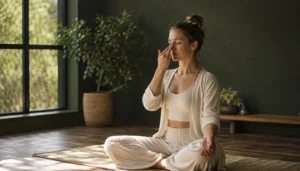
- Exhale 8 seconds through the nose (or through the mouth with lips almost closed, similar effect).
- No retention. No pause between inhale and exhale, or between exhale and the next inhale.
- Five minutes straight. That gives 25-30 complete breaths.
That’s it. The technique is deliberately simple because it has to work even when your head can’t handle complications.
Why it works (physiology)
The 4-8 breath acts directly on the vagus nerve through the respiratory sinus arrhythmia mechanism: the heart speeds up slightly on inhale and slows on exhale. When the exhale is longer than the inhale, the net effect is functional bradycardia — a slowing of heart rate.
The vagus nerve, detecting long exhalations, activates the “vagal brake”: ventral parasympathetic branch, the one that produces calm-alert. The opposite of what anxiety does (which activates sympathetic). That’s why 5 minutes can reverse an acute crisis: through breath, you’re doing the opposite of what anxiety is doing to your body.
When to use it
- Acute anxiety crisis: 5 minutes. If very high, start with 3-6 (more accessible) and progress to 4-8.
- Before sleep: 5 minutes in bed. The most effective known practice for falling asleep quickly.
- Before a stressful situation: presentation, hard conversation, medical appointment. 3-5 minutes before.
- In transition between day roles: coming home from work, shifting from caring for others to caring for yourself.
- Daily maintenance: 3 minutes × 2 times daily reduce trait anxiety in 4-6 weeks.
Variants by level
3-6 (beginner or very acute crisis)
If you’ve never done breathing practice or if you’re mid-crisis, start with 3-6 (inhale 3, exhale 6). More accessible. The 1:2 ratio between inhale and exhale is what matters, not the absolute seconds.
4-8 (standard)
The default recommended ratio. Works for most.
5-10 (intermediate)
When 4-8 feels natural and silent, you can extend to 5-10. Don’t go beyond without guidance.
6-12 (advanced, specific contexts)
Only in people with well-trained respiratory capacity and no cardiopulmonary pathology. Not needed for effect: 4-8 already delivers the main benefits.
“Prolonged exhalation is the fastest non-pharmacological intervention that exists on the autonomic nervous system.”
Stephen Porges, The Polyvagal Theory (2011)
How to practise it well
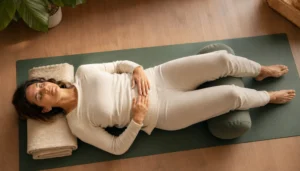
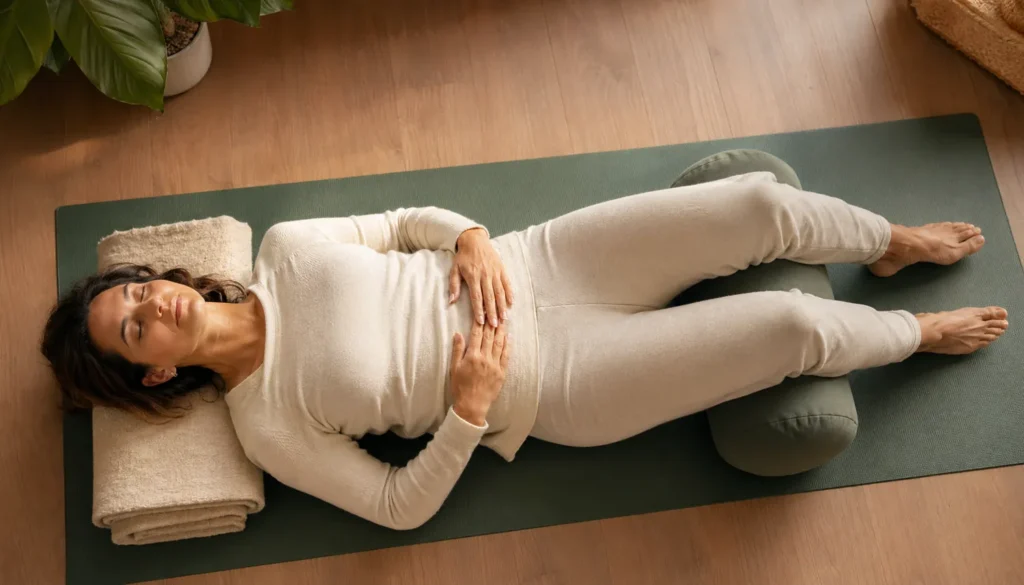
- Posture. Seated with back supported, or lying. If in crisis, lying is better.
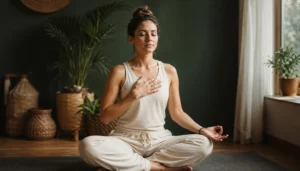
- Hand on the abdomen. So the breath is diaphragmatic, not thoracic.
- Count softly. Mentally “one-two-three-four” on inhale, “one-two-three-four-five-six-seven-eight” on exhale. Don’t obsess over precision: what matters is the proportion.
- If you get dizzy after a few breaths, return to normal breath. It’s a sign you’re slightly hyperventilating. Drop to 3-6.
- Continue 5 minutes. Set a timer at first if helpful. After a few weeks, you’ll know when 5 minutes have passed without a clock.
Common mistakes
- Trying to extend to 4-12 from the start. Too much for most. Result: hyperventilation.
- Doing thoracic breathing instead of diaphragmatic. The abdomen should expand on inhale, not the chest.
- Forcing the air out. The 8-second exhale is passive, not pushed. You let it leave, you don’t expel it.
- Expecting effects in 30 seconds. Needs at least 2-3 sustained minutes for the vagal system to respond.
When it doesn’t work (and what to do)
- If it persistently makes you dizzy: probably hyperventilating. Drop to 3-6 and rebuild over a few weeks.
- If anxiety is very high and you can’t reach the rhythm: start only with long exhale without counting, simply “exhale longer than you inhale”. A free version that also works.
- If you don’t notice effect after 5-6 sessions: consult a professional. Very resistant anxiety needs psychotherapeutic or pharmacological approach.
If your anxiety is persistent, an individual therapeutic yoga session lets us build a personalised protocol where the 4-8 breath is part of broader work.