In grief there are moments when words don’t yet arrive. You know something has broken, you know it hurts, but no sentence names it. And yet, the body needs to express what the mind cannot yet order. Music offers that space words cannot occupy yet.
Here is how music accompanies grief processes from music therapy and therapeutic voice work, what clinical research says, and how I integrate it into my yoga-for-grief work in Barcelona. I write from my training as Master in Music Therapy (UAB) and twenty years accompanying grief in private practice.
Why music works where other interventions don’t reach

Grief lives simultaneously in the body, in emotion and in cognition. Verbal psychotherapy works cognition and, by extension, part of emotion. But the bodily dimension of grief — the chest pressure, the throat knot, the breathlessness — often falls outside the reach of words. That’s where music comes in.
Three documented mechanisms of how music acts in grief:
- Parasympathetic stimulation via vagus nerve. Sustained sound (sung or heard) activates the vagal brake and reduces sympathetic activation accompanying acute grief.
- Emotional processing without language. Music activates cerebral areas (limbic cortex) that process emotion independently of language. Allows “feeling what cannot be said”.
- Social and communal support. Collective grief-singing traditions (farewell songs, ritual chants) fulfil psychosocial functions documented in clinical anthropology.
The 4 ways to work music in grief
1. Receptive listening
Listening to carefully selected music — music the bereaved associates with the lost person, or music classically accompanying deep emotional processes. A receptive music therapy session is not “background music”. It is guided listening, with silence between pieces, and the possibility of speaking about what arises.
2. Own voice (no technical singing)
Holding a vocal sound — long vowel, OM, mantra — across several breaths. The body’s own vibration is nervous regulation. No “knowing how to sing” required.
3. Sound therapy with bowls
Receiving sustained Tibetan-bowl sound in a sound-therapy session. Passively received vibration acts on the autonomic nervous system and, in many cases, facilitates emotional release without need for words.
4. Vocal or instrumental improvisation
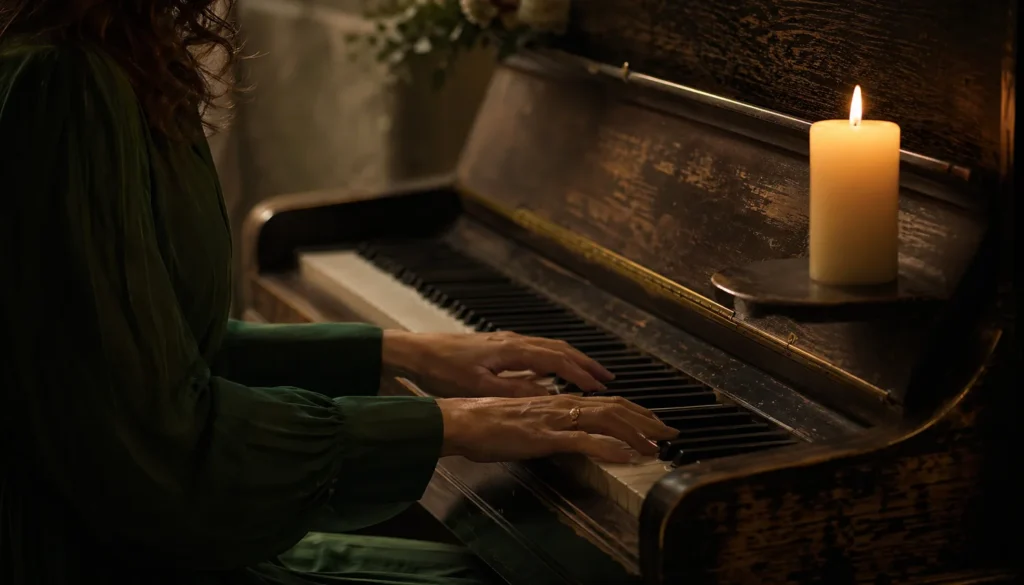
For people with some musical familiarity or those who need it. Improvising sounds without preset structure — at the piano, with the voice, with a simple instrument — is a way to “say what cannot be said”. Requires professional accompaniment.
“In grief, music doesn’t console: it accompanies. It offers a space where the body can hold what the mind cannot yet integrate.”
Pauline Boss, Loss, Trauma, and Resilience (2006)
What research documents
Studies in journals like Journal of Music Therapy and Death Studies document in grief:
- Reduction of depressive symptoms in prolonged grief after 8-12 week music-therapy programmes.
- Sleep improvement in acute grief.
- Reduction of anticipatory anxiety in grief from terminal illness (palliative care).
- Facilitation of ritual farewell when family-chosen music is incorporated.
Music does not “cure” grief. Grief is not cured. It is accompanied, integrated, transformed. Music is one of the oldest and best-documented companions.
How I integrate it into yoga for grief
In my yoga-for-grief work in Barcelona I combine three dimensions:
- Restorative yoga with sustained postures and abundant support. The body receives safety first.
- Pranayama with prolonged exhale (4-8, bhramari). Autonomic nervous system regulation.
- Own or received sound. Sustained OM, therapeutic voice, occasionally sound therapy with bowls at closing. Here the specific musical dimension enters.
Sessions are individual or in small groups (max 6 people) where everyone shares the same process. Other people in grief is, in itself, therapeutic: grief isolates, and sharing accompanied silence restores connection.
When it isn’t the tool
- Acute grief in the first two weeks after the loss (priority: rest, containment, no more stimulus).
- Complicated grief with severe depression or suicidal ideation (priority: psychiatry and psychotherapy).
- People with specific aversion to music (yes, it exists).
If you’re going through grief and think this combination may help, schedule an initial conversation. I’ll explain how I work and we’ll see together if it’s the moment.