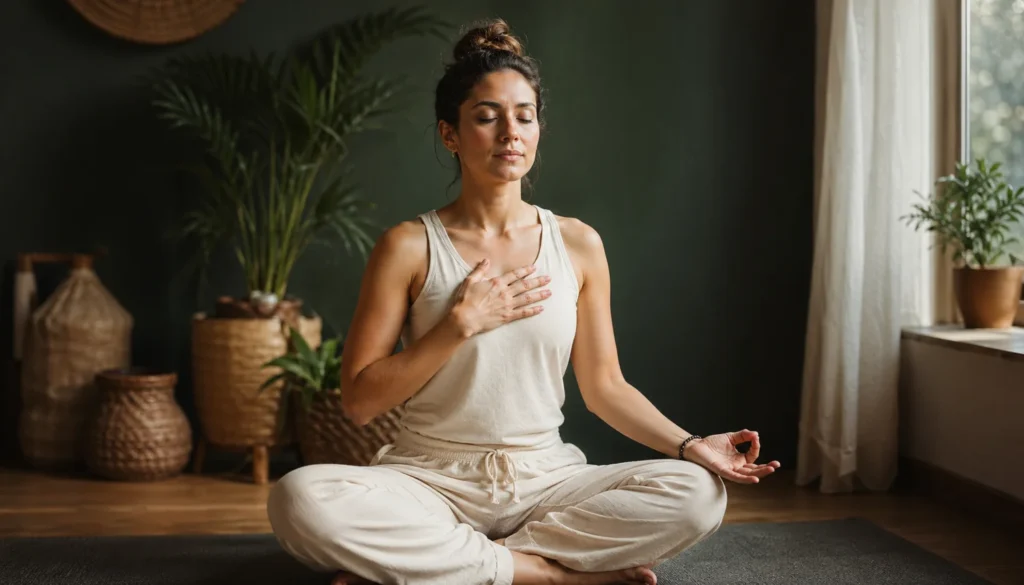
Ujjayi pranayama, also known as “ocean breath” or “victorious breath”, is probably the most-used pranayama in modern yoga. It accompanies almost any vinyasa, ashtanga or hatha practice. And, paradoxically, it is one of the least taught in detail. Most people learn it by imitating what the teacher does without knowing exactly what is being done or why.
Here is ujjayi in detail: how it actually works, what physiological effect it produces, how to integrate it into asana practice, what ratios to use and the precautions.
What ujjayi is and why it’s called “ocean”

Ujjayi comes from ud (“upward”) and jaya (“victory”). Literally “victory of ascending air” or, freely, “expansive breath”. The vibratory sound it produces — similar to ocean waves breaking, or to breathing on a cold window — has given it the colloquial name “ocean breath”.
The sound is generated by soft glottal closure (the opening between the vocal cords), creating slight resistance to airflow on both inhale and exhale. That resistance has three physiological effects:
- Slows breath rate without conscious effort.
- Increases attention by making breath audible (self-feedback).
- Stimulates the vagus nerve through the vocal cords (recurrent vagal branch).
How to find ujjayi (step by step)
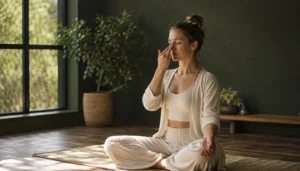
- Sit comfortably in sukhasana or on a chair with upright spine.
- Breathe normally through the nose for a few breaths to release tension.
- Open your mouth and whisper “haaa” on exhale, as if fogging up a window. Repeat 3 times. You’ll notice a soft throat sound.
- Close your mouth and keep that same internal throat gesture. Continue exhaling through the nose. The sound shifts slightly but remains audible.
- Apply the same gesture to the inhale. More subtle. If you don’t notice it, don’t force it: start with ujjayi exhales only.
- The sound must be soft, audible to you (and at most a metre away). If the person beside you hears it, you’re using too much force.
How to integrate it into asana practice
Ujjayi accompanies postural practice perfectly for two reasons:
- It informs you of your state. If the sound breaks or gets very loud in a posture, it’s a sign you’re overworking. Exit or reduce intensity.
- Keeps attention bound to the body. Hard to drift if your own breath is sounding.
Recommendation: start incorporating ujjayi only in long standing postures. After a few weeks, extend to sun salutation. With time, hold it through the entire practice except specific pranayamas.
Breath ratios
- In postural practice: natural ratio, ideally 4-4 or 4-6, adjusted to sequence pace.
- In seated pure ujjayi: 5-5 initially, progressing to 6-6 or 8-8.
- In pre-savasana relaxation: 4-8 (short inhale, exhale double).
“Ujjayi turns each breath into a mantra. When breath has sound, the mind listens.”
T.K.V. Desikachar, The Heart of Yoga (1995)
Common mistakes
- Darth-Vader-style throat sound. Too intense. Soften the sound quality.
- Ujjayi only on exhale. The easiest. But the inhale also becomes ujjayi as you learn.
- Forced ujjayi in postures that don’t allow it. If the sound breaks in an intense posture, don’t force it. Natural breath during that posture.
- Confusing ujjayi with mouth breathing. Air enters and leaves through the nose; the sound is in the throat, not the mouth.
Benefits of regular practice
- Progressive increase in functional lung capacity.
- Improved sustained attention during practice.
- Reduction of anticipatory anxiety (in those who practise it before stressful situations).
- Sensation of internal heat (hence its use in cold climates during practice).
- Greater meditative depth when used before sitting.
When not to practise
- Acute throat inflammation or irritation.
- Undiagnosed dysphonia or vocal-cord issues.
- Severe uncontrolled hypertension in its most intense form.
- Pregnancy: very soft version is safe, but no added retentions.
If you want to learn ujjayi properly with direct correction, at my Barcelona studio we integrate ujjayi in every hatha yoga practice.