Thousands of years before the word «psychotherapy» existed, humanity already sensed something neuroscience now confirms: music changes us inside. It calms us, awakens us, accompanies us in our darkest moments. When that power becomes a clinical intervention, we call it music therapy.
If you have ever felt that a song held you in a moment when no advice could ease the weight, this article is for you.
I am Clio Byrne, hatha yoga teacher (RYT 500 by Yoga Alliance) and certified music therapist by the Universitat Autònoma de Barcelona (UAB). In this article I will share what music therapy actually is, what it is not, how it works on the nervous system, where it can help, and how it differs from sound therapy and therapeutic voice work.
What music therapy is (and what it is not)
Music therapy is the clinical, planned and professional use of music and its elements —rhythm, melody, harmony, silence, voice— to support desired changes in physical, emotional, social and cognitive health. It is led by a certified music therapist who designs the session around specific therapeutic goals.
This is not playing background music to relax. It is not making a feel-good playlist. It is not listening to mantras on YouTube hoping something will happen.
The difference is clinical intent + professional training + follow-up. Just as a yoga class can be very beneficial, but a therapeutic yoga session for grief is something else: there is an assessment, a method and continuity.
From Aristotle to UAB: a brief history
The idea that music heals is as old as culture. Aristotle wrote about musical catharsis. In ancient Egypt, music was part of healing rituals. Shamans across nearly every traditional culture have used drum and voice as medicine.
As an academic discipline, however, music therapy is relatively young. It was formalised in the United States in the mid-20th century, when volunteer musicians entered hospitals to support World War II veterans living with trauma. Today it is a recognised university qualification across Europe, the United States and Latin America.
In Spain, one of the leading references is the Master’s Degree in Music Therapy at the Universitat Autònoma de Barcelona, where I trained. That is where I learned what distinguishes clinical music therapy from any other form of «music that feels good»: the method, the therapeutic gaze, and the professional responsibility.
How music acts on the nervous system
When a melody plays, measurable changes happen in your body:
- Rhythm regulates heart rate. A slow, steady pulse invites your heart to synchronise and slow down.
- The human voice activates the vagus nerve. Singing, humming, vibrating with the throat stimulates the parasympathetic branch of the nervous system —rest and digestion—.
- Music evokes emotional memory. The limbic system responds to melodies linked to life moments, allowing access to emotions that words cannot reach.
- The silence between notes is as therapeutic as the notes themselves. Music therapy works with the space where there is no sound: that is where what was hidden tends to appear.
«Music can lift us out of depression or move us to tears — it is a remedy, a tonic, orange juice for the ear. But for many of my neurological patients, music is even more — it can provide access, even when no medication can, to movement, to speech, to life.»
— Oliver Sacks, Musicophilia (2007)
Clinical applications: when to turn to music therapy
The recognised indications are broad. In my practice I see four main areas.
Anxiety and chronic stress
Music paired with conscious breathing exercises lowers cortisol and returns the body to a state of safety. Especially useful when the rational mind has tried everything and needs a non-verbal route.
Grief and loss
Grief lives in the body. Music —chosen with care and professional guidance— allows access to pain without overwhelming it. In my yoga for grief classes I integrate elements of music therapy precisely for that reason: there are moments when the body needs sound before words.
Trauma and emotional regulation
In trauma processes, music offers a bridge. It does not force the narrative. It allows the nervous system to feel safe again while it processes what happened.
Neurorehabilitation
People with Alzheimer’s remember songs from their youth long after they have forgotten the names of their loved ones. People with aphasia (language loss) sing words they cannot speak. That is not magic: it is brain plasticity guided by music.
Individual vs group sessions: what to expect
Individual sessions are a one-to-one space, deeply personal. I design each session around your story, your moment and the goals we agree on at the start. We work with active listening, improvisation with accessible instruments (no music background required), voice, silence, and —when it serves— body movement.
Group sessions have a different density. Something appears that does not appear in one-to-one work: the mirror of the group. Singing or vibrating alongside other people in grief, for example, dissolves isolation. My singing classes in Barcelona also fit here — they are not strictly clinical music therapy, but they share many of the therapeutic principles.
Music therapy, sound therapy and therapeutic voice: the differences
Three terms often confused:
- Music therapy: regulated clinical intervention with a certified therapist and follow-up.
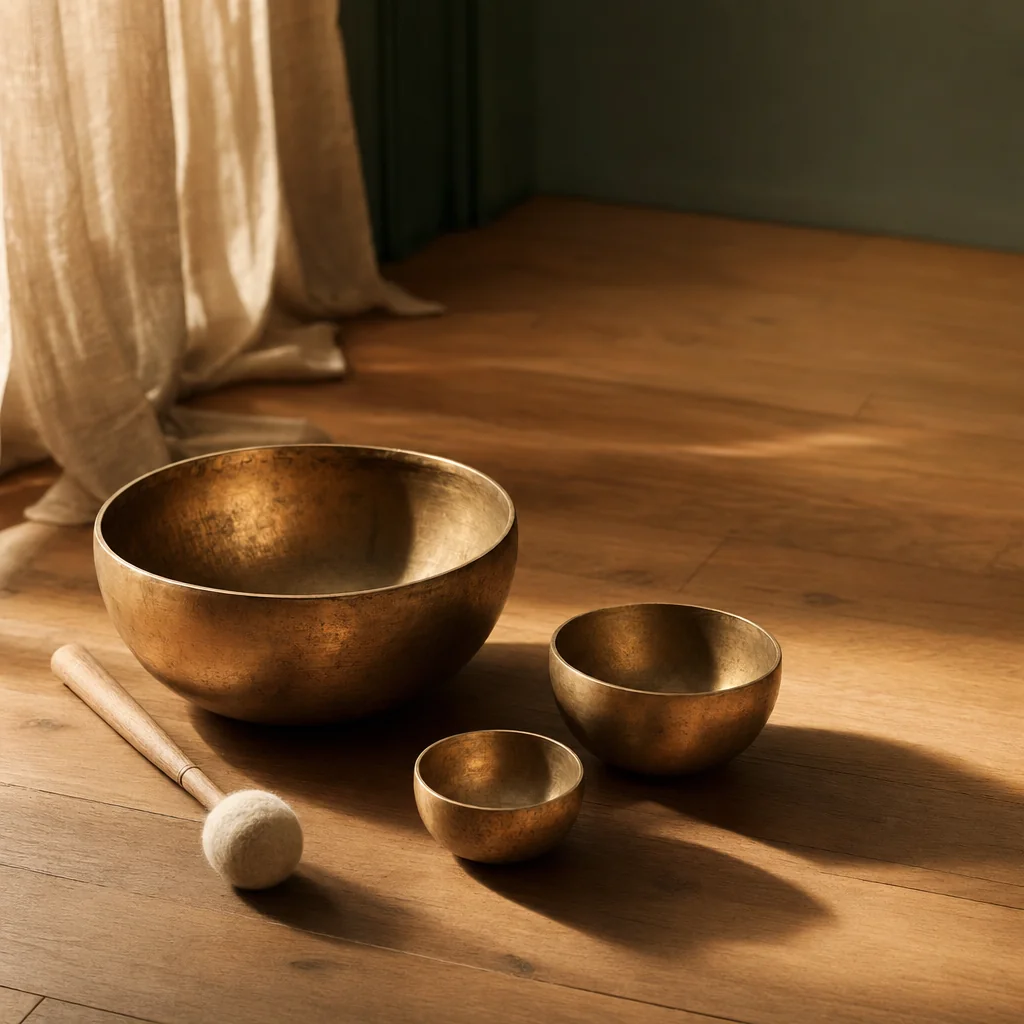
- Sound therapy: use of sound (singing bowls, gongs, tuning forks) to induce deep relaxation. Closer to the wellness field.
- Therapeutic voice work: specific work with your own voice as an instrument of regulation and expression.
The three can coexist. In my practice I integrate all three depending on what the person needs. If the more sound-and-vibration dimension calls you, see the therapeutic voice and sound therapy page.
What a first session with me looks like
I share this in case it helps you decide whether to take the step. A first session lasts about one hour.
- Initial conversation (10-15 min): we talk about what brings you here, how you are, your relationship with music, what you hope for.
- Guided practice (30-40 min): based on what you shared, I propose an experience. Receptive listening, improvisation with accessible instruments, voice work, subtle movement with music — whichever fits.
- Closing and dialogue (10-15 min): we integrate what has emerged. Sometimes words appear, sometimes only body sensations. Both are valid.
Sessions take place at my studio in Horta, Barcelona. If you come from out of town, I can also guide sessions online when the case allows. More about my training and path on the about me page.
Frequently asked questions
Do I need to know music or have a «good ear»? No. We work with your body, your voice and your natural listening. Anyone can benefit, regardless of whether you have ever sung «Happy Birthday» in tune.
Is it the same as going to a concert or listening to my favourite playlist? No. Everyday music keeps you company; music therapy intervenes. There is method, goal and professional follow-up.
Does it replace psychotherapy? No, it complements it. I work in collaboration with psychologists and psychiatrists when the person is already in a parallel therapeutic process.
How many sessions do I need? It depends on the goal. For specific processes (situational anxiety, support during a recent loss), 6 to 10 sessions are usually enough. For deeper processes, we plan in three-month blocks that we review together.
Is it covered by public health? No. It is private complementary therapy. Some private health insurance plans cover it partially; check your policy.
If after reading this you sense that music therapy could help you, I invite you to book an introductory session. You do not need to have «something serious» or a diagnosis to come. It is enough to feel that your body is asking to be listened to in a different way.