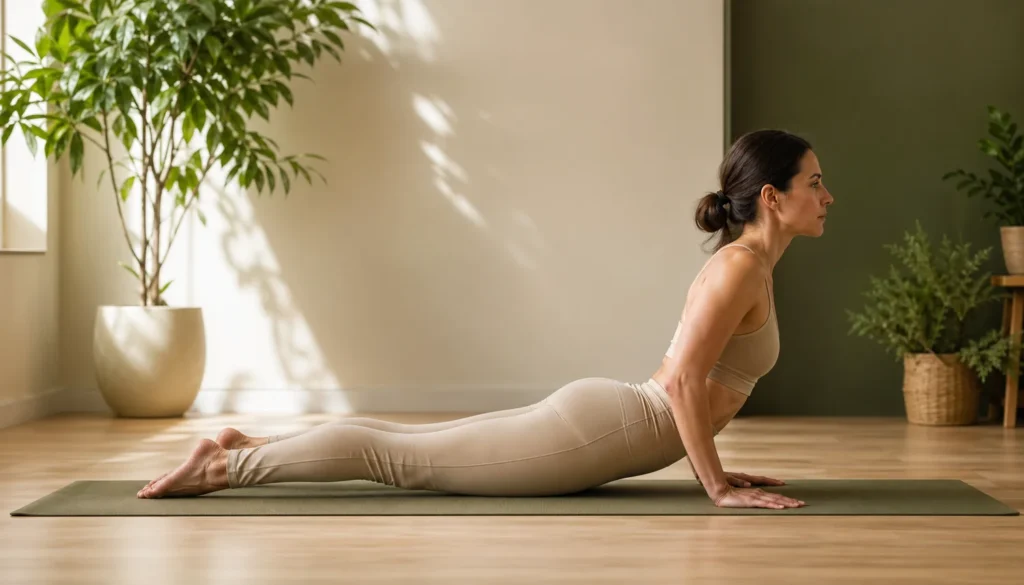
Cobra pose looks simple. Lie face down, hands on the mat, lift the chest. Anyone can do it. And yet it is one of the most misread postures in modern yoga: most people do a version that strains the lower back instead of mobilising the upper back, which is exactly the opposite of what the posture is for.
Here is bhujangasana step by step, with the detail of what should arch (and what shouldn’t), progressive heights by body, common mistakes and precautions by lumbar condition.
What bhujangasana is and does
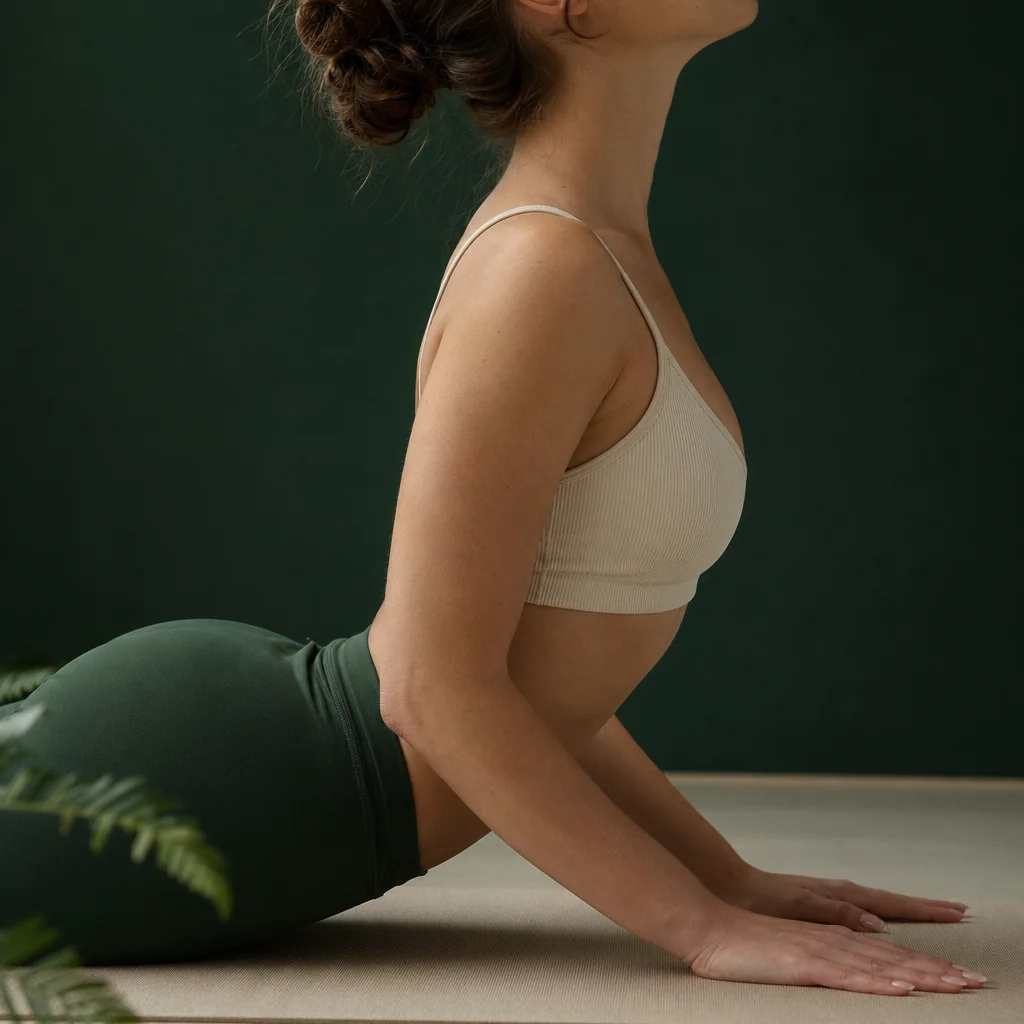
Bhujangasana — from bhujanga, “snake” — is the active spinal extension from prone. The key difference with other extensions (urdhva mukha, salabhasana, urdhva dhanurasana) is in how the arch is distributed: cobra is a thoracic extension, not lumbar. When you do it correctly, you feel the work in the mid-back, not the lower back.
Benefits:
- Thoracic mobility (a very stiff zone in most sedentary adults).
- Chest and diaphragm opening (improves breath).
- Paravertebral muscle activation.
- Soft parasympathetic stimulation through sustained abdominal pressure.
Correct alignment step by step
- Lying prone. Forehead to the mat. Legs extended, feet together or hip-width, insteps on the floor.
- Hands under shoulders. Elbows close to the body, not flared.
- Pubic bone to floor, soft glutes. Don’t squeeze the glutes: that compresses the lumbar.
- Inhale and lift the chest. Initiate the movement from the sternum, not from the arms. The height is set by your thoracic spine, not by arm strength.
- Gaze slightly forward, neck in line with the thoracic spine. Don’t force the head back.
- Shoulders away from ears. External shoulder rotation, scapulae sliding towards hips.
- Soft elbows, not necessarily extended. If you can’t fully extend them while keeping the thoracic arch, don’t extend them. Your body sets the height.
- Hold 5-8 breaths and lower with control on the exhale.
The 4 typical mistakes
- Pushing with the arms. The arch comes from the chest, not the arms.
- Hyperextending the lumbar. Pinching sensation in the lower back. Cause: forcing height without thoracic mobility. Fix: lower the height, engage abdomen to lengthen the lumbar zone.
- Hunched shoulders. Cause: arms doing too much work. Fix: external shoulder rotation, scapulae down.
- Neck forced back. Cause: wanting to look at the ceiling. Fix: neutral neck in line with thoracic spine.
The 3 progressive heights
- Low cobra. Only the chest lifts off the floor. Bent elbows, forearms parallel to floor. Intense paravertebral work. The default version for almost every body.
- Mid cobra. Elbows partially extended.
- Full cobra. Elbows nearly extended, broad spinal arch. Only if the thoracic and lumbar flexibility allow without pinching.
Most practitioners should stay in low and mid cobra for years before progressing.
“In bhujangasana what matters is not the height of the chest but the quality of the arch. A 30 cm thoracic arch is more useful than a 60 cm lumbar arch.”
Donna Farhi, Yoga Mind, Body and Spirit (2000)
Precautions by your lumbar condition
- Healthy lumbar: any height is acceptable. Progress by mobility.
- Stiff lumbar without pathology: start with sustained low cobra. Work thoracic mobility with cat-cow before any extension.
- Disc herniation or protrusion: consult with your physiotherapist. Moderate extension is indicated in many herniations (extension = McKenzie position), but professional confirmation is key.
- Lumbar stenosis: generally contraindicated. Extensions close the spinal canal space.
- Spondylolisthesis: contraindicated without supervision.
- From 2nd trimester pregnancy: contraindicated (abdominal compression).
How to combine with other postures
Bhujangasana works very well:
- After cat-cow (spine preparation).
- As part of the sun salutation.
- Compensated with soft forward folds (apanasana, balasana) afterwards.
- Before twists (chest opening prepares the spine to rotate).
If you want to deepen bhujangasana and other basic postures, the 12 basic asanas of yoga include the keys to each one. And in class with direct correction, learning is much faster.