Chakras are one of yoga’s most popular concepts and also one of the most misread. They have shifted from being a symbolic construct of the medieval tantric tradition to appearing on Instagram banners and on pseudoscience websites promising to “align” them through any intervention. Let’s separate original tradition from contemporary mythology.
Here are the seven chakras from three angles: what they are in the tantric tradition (real origin), what modern research says about correlatable anatomical structures, and how to work with them in yoga practice without falling into spiritual dogma. I write from the classical training I received at Sivananda Ashram (India) and twenty years integrating these ideas in contemporary practice.
What chakras are (tantric origin)
The Sanskrit term chakra literally means “wheel” or “circle”. In the medieval tantric tradition — concretely in texts like the Sat-Chakra-Nirupana from the 16th century — chakras are described as subtle energy centres distributed along the body’s central axis (sushumna), connected by channels (nadis). They are not anatomical structures or glands: they are a symbolic map for guiding meditative practice.
The seven-chakra system (the most popular today) was popularised in the West in the 20th century through Arthur Avalon (Sir John Woodroffe). Other traditional systems exist with more or fewer chakras (some texts speak of 6, others of 12). “Seven” is a convention, not an anatomical fact.
The 7 chakras and their contemporary correlation
1. Muladhara — root chakra
Base of the spine, pelvic floor. Associated with basic safety, survival, body connection. Contemporary correlation: pelvic floor tone and baseline autonomic system. Practice: wide-base standing postures (warrior II, malasana), diaphragmatic breath.
2. Svadhisthana — sacral chakra
Below the navel. Associated with creativity, sexuality, emotional fluidity. Contemporary correlation: pelvic and reproductive region, hypothalamic axis. Practice: hip openings (baddha konasana, soft pigeon), pelvic circles.
3. Manipura — solar plexus chakra
Solar plexus, navel. Associated with personal power, self-esteem, will. Contemporary correlation: digestive system and solar plexus (a real major nerve centre). Practice: strength postures (plank, navasana), moderate kapalabhati.
4. Anahata — heart chakra
Centre of the chest. Associated with compassion, connection, love. Contemporary correlation: thoracic region and vagus nerve (which passes through the thorax). Practice: chest openings (cobra, bridge, ustrasana), bhramari.
5. Vishuddha — throat chakra
Throat. Associated with expression, communication, authenticity. Contemporary correlation: larynx, thyroid, vocal cords (with real vagus connection). Practice: vocal work, sustained OM, soft shoulder-stand.
6. Ajna — third eye chakra
Between the eyebrows. Associated with intuition, clarity, inner perception. Contemporary correlation: hypothalamus and pineal gland. Practice: meditation focused on the forehead, trataka (steady gaze on a candle).
7. Sahasrara — crown chakra
Crown of the head. Associated with transcendent connection, dissolved ego, samadhi. Contemporary correlation: cerebral cortex. Practice: deep silent meditation, sustained dhyana.
“Chakras are not structures to align: they are maps to guide attention. Their value is in what they help you observe, not in what they promise to heal.”
Georg Feuerstein, The Yoga Tradition (1998)
What chakras are NOT
- They are not endocrine glands. Although symbolically associated, no evidence of direct anatomical correspondence.
- They don’t get “cleansed” or “aligned” by external magic interventions. That’s marketing.
- They aren’t “blocked” like plumbing. It’s a symbolic metaphor.
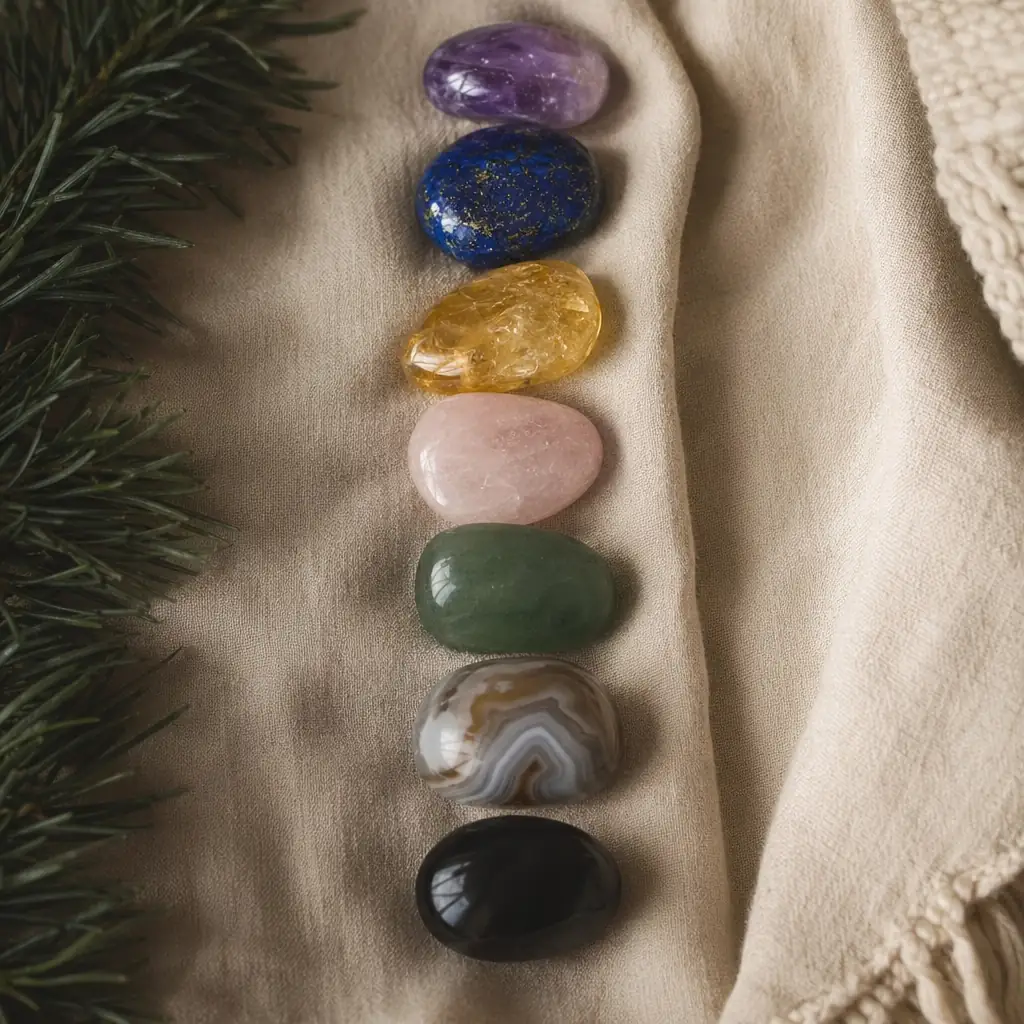
- They don’t require specific crystals to work. Crystal use is a superimposed cultural layer, not part of the original tantric system.
How to work with the chakra system (without dogma)
My practical recommendation: use chakras as an attention map, not entities to manipulate.
- One week, one chakra. In that week’s practice, direct attention to the body zone associated with that chakra. Notice what you feel (tension, sensation, emotion).
- Practise postures that work that zone. Without expecting specific results. Observation is the practice.
- Short journal at the end of the week: what did I notice in this zone? What emotions arose when I worked it?
- Move on to the next chakra. In seven weeks you’ll have worked all seven with focused attention.
What changes with this practice: you don’t “align chakras”. You change your interoception. You learn to notice your body more precisely, which has real effects on emotional regulation, posture and sleep.
If you want to work yoga’s symbolic dimension alongside rigorous postural practice, at my Barcelona studio I integrate tradition and contemporary practice without magical promises.