A complete yoga practice doesn’t need 80 different postures. It needs 12 well-built basic asanas covering all the geometry of the body: standing, seated, extending the spine, flexing it, twisting, balancing, inverting and resting. Master these twelve and you can practise yoga fully for the rest of your life without needing a single new posture.
This selection comes from a mix of the Sivananda approach (where I trained in India), Iyengar’s rigour and twenty years of adapting these postures for diverse bodies. They appear here in their logical practice order with the physiological sense of each.
The 12 basic asanas
1. Tadasana — mountain pose
The root posture. Teaches you to stand with axis.
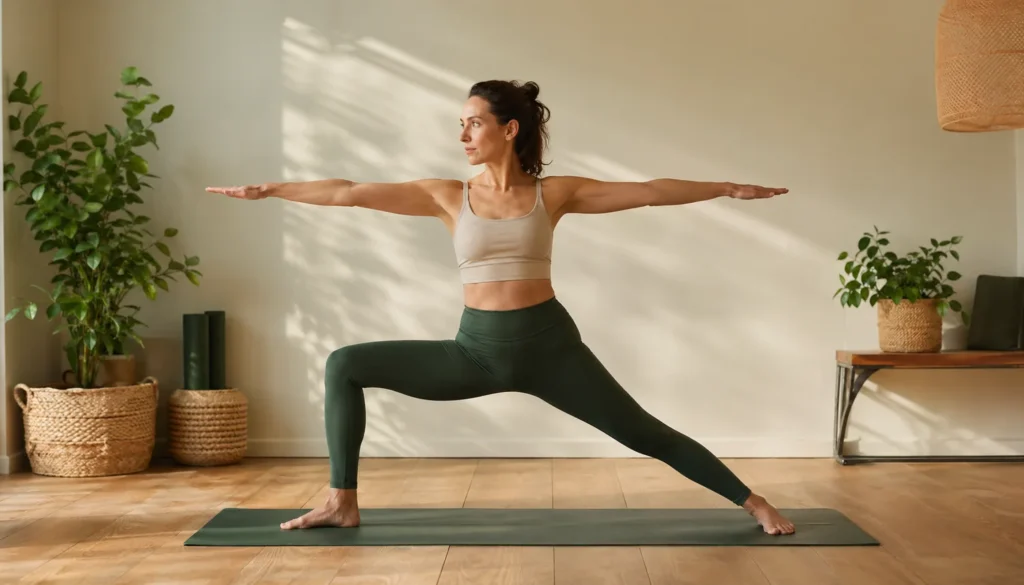
2. Virabhadrasana II — warrior II
Front leg bent (knee over ankle, no further), back leg extended with foot at 45°, arms in cross parallel to the floor, gaze towards front middle finger. Builds leg strength, hip opening, endurance.
3. Trikonasana — triangle
Lateral opening of spine and hip. Hand on a block if it doesn’t reach the floor. Height doesn’t matter: the continuous body line does.
4. Uttanasana — standing forward fold
Releases the spine and hamstrings. Knees softly bent. Head heavy towards the floor. Calms the nervous system.
5. Adho mukha svanasana — downward facing dog
The most versatile posture. Strengthens, lengthens, regulates. Bend the knees if needed.
6. Phalakasana — plank
Core strength. If you can’t hold, drop to the knees. 30 seconds as an intermediate target.
7. Bhujangasana — cobra
The spinal extension par excellence. Thoracic arch, not lumbar.
8. Balasana — child’s pose
Active rest. Available any time you need to pause. Forehead to floor or to a block, hips back to heels.
9. Sukhasana with twist
Cross-legged on a cushion, one hand behind, one hand on the opposite knee, twist the torso. The twist closes the body’s horizontal plane.
10. Vrksasana — tree
Single-leg balance. Other foot on thigh or calf (never on the knee). Hands in namaste or arms overhead.
11. Setu bandhasana — bridge
Gentle inversion. Supine, feet near glutes, lift the hips by pressing the feet into the floor. Chest opening and glute work.
12. Savasana — corpse pose
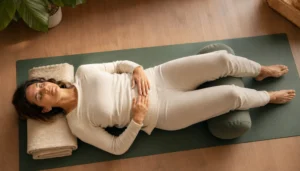
The most important one. Without savasana, the rest doesn’t integrate. Minimum 5 minutes at the end of every practice. Left side if pregnant.
“In these few asanas, well practised, the whole of yoga is contained.”
B.K.S. Iyengar, Light on Yoga (1966)
How to build a practice with these 12
A perfectly balanced 30-minute session with these 12 postures:
- Opening (5 min): Tadasana 1 min · conscious breath 2 min · sun salutation 3 gentle rounds.
- Standing postures (10 min): Virabhadrasana II 1 min each side · Trikonasana 1 min each side · Vrksasana 1 min each foot. Balasana 1 min.
- On the floor (10 min): Phalakasana 30 sec · Bhujangasana 5 breaths · Adho mukha svanasana 5 breaths (3 alternating rounds). Setu bandhasana 1 min · Sukhasana twist 1 min each side.
- Closing (5 min): Uttanasana 1 min · Savasana 4 min.
Common mistakes with these 12
- Skipping tadasana because it’s “too simple”. Tadasana is where you learn alignment.
- Forcing the knees in virabhadrasana II or trikonasana.
- Doing downward dog with a rounded back to plant the heels.
- Skipping savasana at the end for lack of time. Better cut another posture than this one.
If you want to learn these 12 asanas with direct teacher correction, at my Barcelona Horta studio we work with classical hatha yoga using them as the spine.